Research.Knowledge.Technology.Learning.
I research, organize, teach, and build, turning scattered collections, complex projects, and new institutions into systems and services people can use.
Featured work
Three projects, three kinds of impact
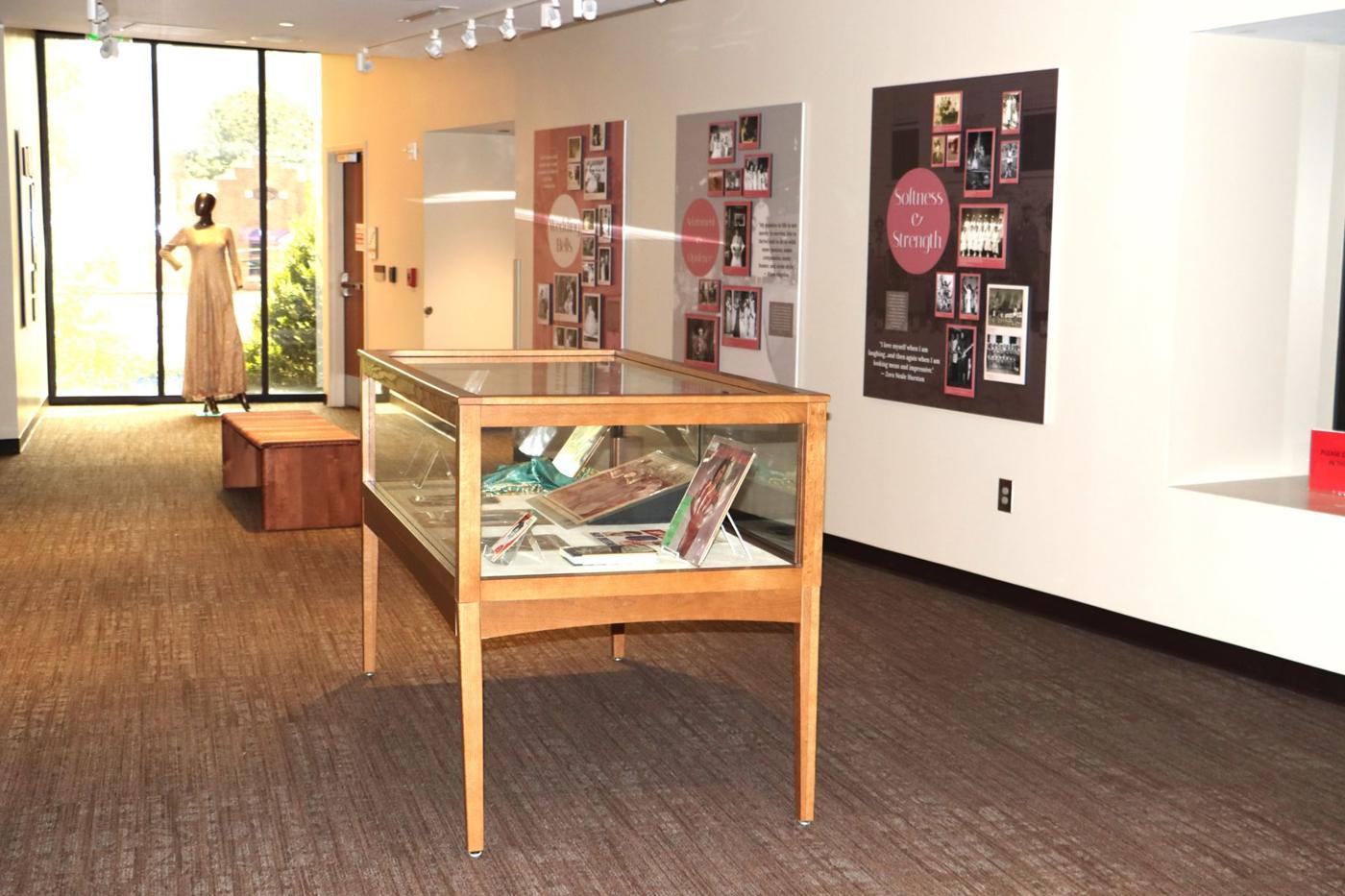 Photo: Frederick Cox
Softness Was Always Ours
Two 2026 ACRL/RBMS Leab Awards
A tender tribute to Black women and girls, curated as an Omeka digital exhibit and a physical gallery installation.
Read the case study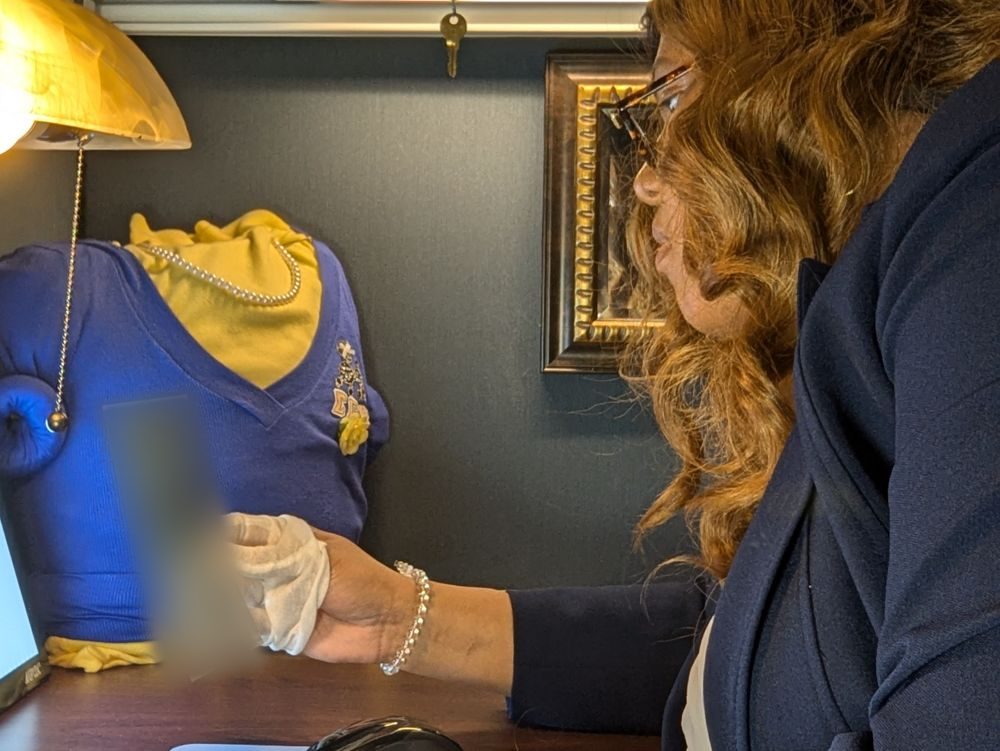 80,000+negatives, 1928–1979
Weems Photographic Negative Project
Fulton County Library System Dewey Award, 2025
Leading a team through item-level arrangement and description of all 80,731 negatives in a 127-linear-foot collection documenting more than five decades of African American life in Jacksonville, Florida.
Read the case study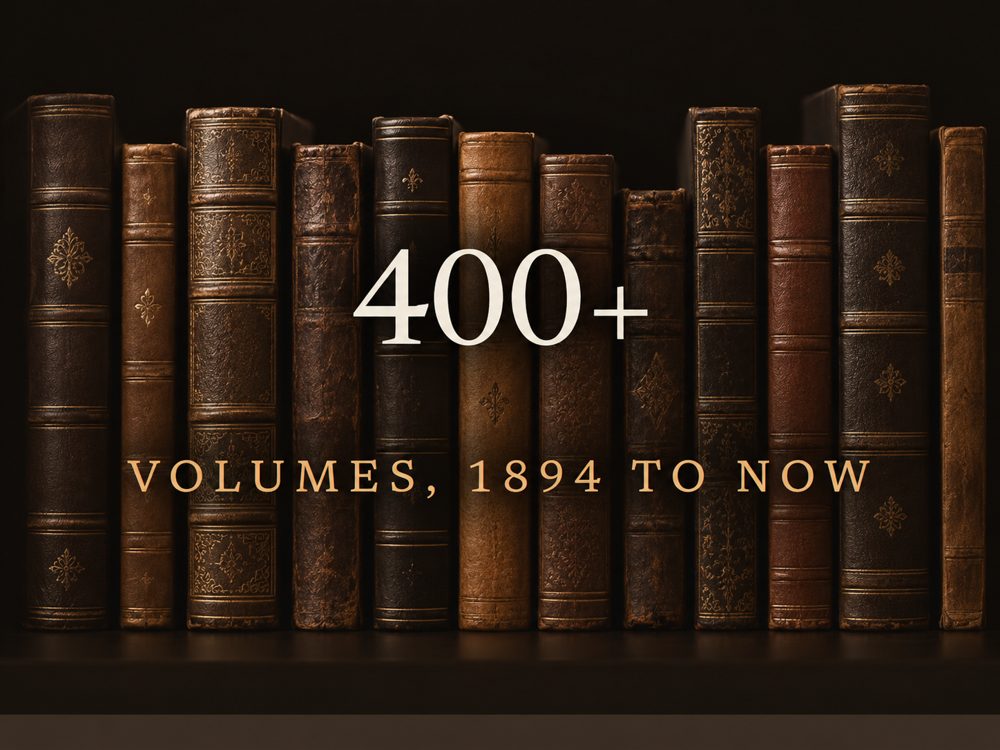
Building Turner Library Services
No accreditation findings on library services
Physical and online library services built from the ground up as a historic seminary became independent.
Read the case study“She sees possibilities and builds them.”
Ammie L. Davis, Ph.D., President & CEO, Turner Theological Seminary
Expertise
Where I can help
Research & instruction
Reference, information literacy, and instructional design for students, faculty, and the public.
Information organization
Archival description, metadata, controlled vocabularies, and digital asset management.
Digital tools, apps & AI
Web applications, digital exhibits, and applied AI with clear human review.
Project & operations leadership
Large-scale projects, workflow design, budgets, and governance, grounded in years as a CFO.
Teaching & speaking
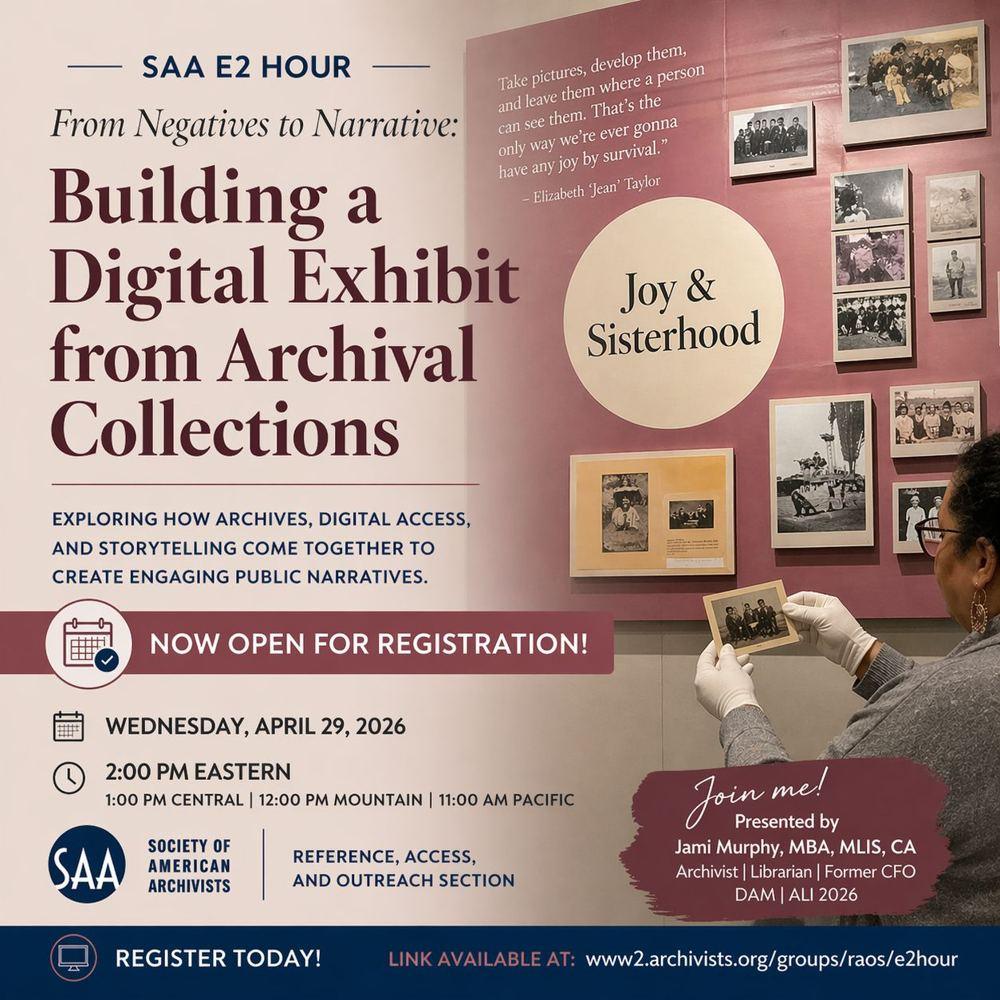
From negatives to narrative
My SAA E2 Hour session on building digital exhibits from archival collections drew record registration for the series. I also teach research skills through workshops, webinars, and classroom instruction.
Proud member of
- American Library Association
- Association of College & Research Libraries
- Reference & User Services Association
- Society of American Archivists
- Academy of Certified Archivists
Home / About
An information professional with an operator’s instincts
My story
I am an archivist, librarian, information strategist, and project manager who brings order, clarity, and creative direction to complex work. I care about making information, systems, and organizations work better, and about the people who depend on them.
Today I serve as Project Archivist at the Auburn Avenue Research Library on African American Culture and History, where I led a team of volunteers and staff in the item-level arrangement and description of the Ellie Lee Weems Photographic Negative Collection: 197 boxes and more than 80,000 negatives, each described individually, documenting five decades of African American life. I also helped build Turner Theological Seminary’s library services from the ground up.
Before libraries and archives, I spent my career as a CFO and controller. I brought that discipline with me: I focus closely on details without losing sight of the larger goal.
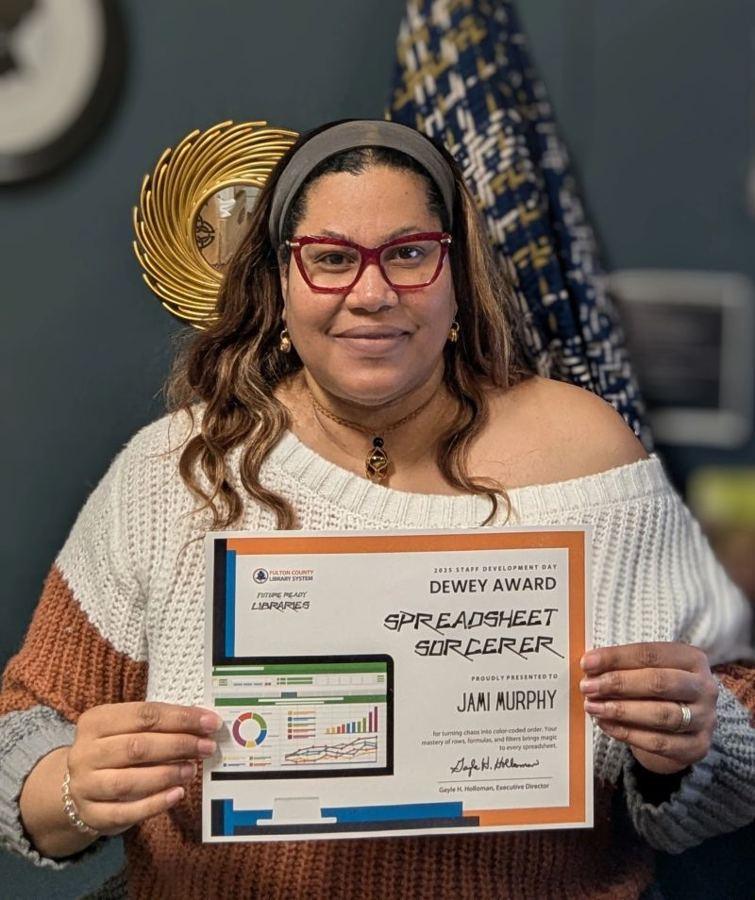
Fulton County Library System, 2025
Career journey
Different chapters, one thread
First chapter
Finance and operations leadership
CFO, controller, and VP of accounting for charter schools, national nonprofits, and growing companies, solving problems involving data, systems, risk, budgets, training, and strategy. Also a fractional CFO and certified fraud examiner.
The pivot, 2024
MLIS and Graduate Certificate in Archival Studies, LSU
Earned together with Distinguished Honors, alongside a Professional Certificate in Digital Asset Management from the University of Wisconsin–Madison.
Library and archives practice
Georgia Gwinnett College · University of Georgia
Reference librarian teaching information literacy and entering repository metadata in DSpace; archival processing and description at UGA Special Collections Libraries.
Building and leading
Auburn Avenue Research Library · Turner Theological Seminary
Project Archivist leading a major photographic collection and award-winning exhibit work; interim librarian helping a newly independent seminary build library services through accreditation.
Leadership & service
Trusted with the profession’s work
Academy of Certified Archivists
Treasurer
Elected in 2026 with 97% of the vote. Oversees the Academy’s finances alongside the board.
Archives Leadership Institute
2026 Cohort, University of Virginia
Selected for the NHPRC-funded national institute for archival leaders.
Society of American Archivists
AI Task Force
Helping shape the profession’s approach to artificial intelligence.
Society of American Archivists
Finance Committee
Bringing finance leadership experience to association governance.
Society of American Archivists
Georgia Key Contact
Connecting Georgia archivists with SAA and supporting peers.
Society of American Archivists
E2 Advisory Board
Advising on the profession’s exhibits and events programming.
Auburn Avenue Research Library
Digital Exhibits & Social Media Taskforce
Analyzed 14 peer institutions, wrote the digital curation and exhibition workflows and guidelines, and combined the team’s work into one document. The taskforce finished 37 days ahead of schedule.
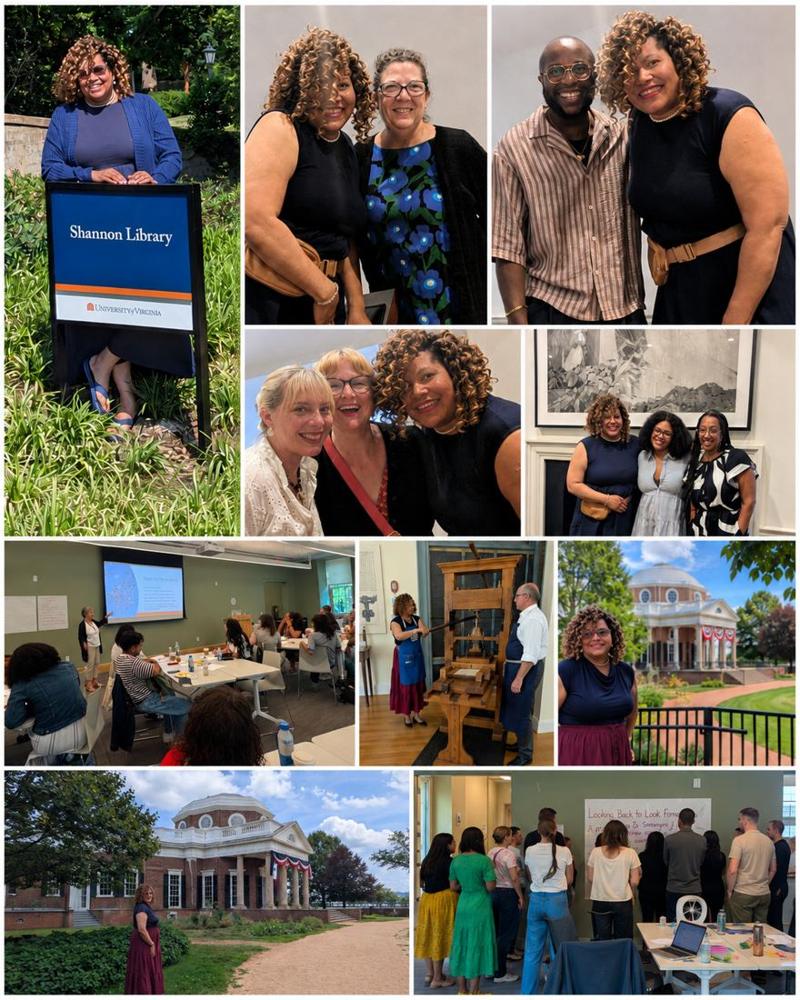
University of Virginia, 2026
Home / Work
Case studies
Each project follows the same arc: the challenge, my role, the process, the impact, and the evidence.
Softness Was Always Ours
Award-winning digital and gallery exhibit at the Auburn Avenue Research Library.
Case studyDesign & Communication
Exhibit panels, instruction decks, outreach, and conference slides I designed.
GallerySoftness Was Always Ours: Project Case Study
How the exhibit was planned, produced, launched, evaluated, and rebuilt.
In-depth case studyEllie Lee Weems Photographic Negative Project
Leading a trained team through item-level arrangement and description of 80,731 negatives, plus 61,667 index cards, prints, and supporting records: 197 boxes (127 linear ft.).
Case studyBuilding Turner Library Services
Physical and online library services for a newly independent seminary.
Case studyResearch Data Management Plan
An NIH Data Management and Sharing Plan written in DMPTool, with a detailed de-identification and access strategy.
Practice planNational Black Arts Festival Records Survey
Collection survey and preservation recommendations for about 54 linear feet of multi-format records, with 88 items digitized.
Case studyBuilding a Digital Exhibit from Archival Collections
SAA E2 Hour presentation with record registration.
PresentationCertified Archivist Exam Prep App
A study app with 1,000+ source-cited questions across the eight ACA domains, adaptive review, and per-domain scoring.
Case studyAn Archival Framework for AI-Assisted Assessment Design
White paper: provenance, description, and appraisal as controls for AI-drafted questions.
White paper- Project
Georgia Gwinnett College DSpace metadata
Archival metadata in the institutional repository for digital access.
- Archives
University of Georgia Special Collections Libraries
Archival processing, description, and collection access work, 2024.
- Workshop
Student-worker career development workshop
Program design and practical information services at Georgia Gwinnett College.
Auburn Avenue Research Library · Photo: Frederick Cox
The challenge
Archival collections hold rich records of Black women and girls, but those records are often framed through struggle alone. This exhibit set out to surface tenderness, joy, and care, drawing on roughly 35 Auburn Avenue Research Library collections, and to present those materials in ways that invite audiences in rather than keep them at a distance.
My role and process
I curated the exhibit from concept to installation: researching the collections, selecting objects, writing the interpretive narrative, and designing the experience across two formats.
- Digital exhibit built and customized in Omeka S, including page structure, custom HTML and CSS, interpretive captions, navigation, and an accessibility-conscious layout.
- Eight interpretive themes: Adornment & Opulence, Resilience in the Everyday, Softness & Strength, Joy & Sisterhood, Wedding Bells, Softness Swims, the Utopian Literary Club, and Softness in Print, plus a timeline.
- Gallery installation with framed photographs, wall panels, and display cases.
- Multimodal engagement: a 50-track companion playlist spanning the 1920s through the 1980s, with full citations, and a recommended-viewing guide.
From proposal to opening
- Planning: wrote the exhibit proposal, built a mood board, and created a production checklist and a slate of programming ideas.
- Curation: designed nine true-to-size panels and wrote a curatorial statement for each.
- Production: sourced and compared print vendors, prepared print-ready files, and coordinated installation of panels, window graphics, and banners.
- Outreach: invited community organizations, placed listings with media and partner networks, and compiled a 93-title reading list cross-checked against library holdings.
The 2026 revamp
In early 2026, I rebuilt the exhibit, physical and digital, around materials from 35 of the library’s collections:
- Selected and digitized 146 new items and reprinted 67 images to recover seven gallery panels.
- Re-engineered 17 Omeka pages in HTML, CSS, and JavaScript, adding a timeline, custom theme tile cards, and new navigation.
- Wrote extended captions for 141 images.
Impact
The 2026 Leab Awards recognized the exhibit for Excellence in Content and for Innovation in Audience Engagement in the digital catalog category, alongside institutions such as the Morgan Library & Museum and the University of Toronto. For the first time in the awards’ history, recipients were chosen by popular vote of ACRL and RBMS members.
“I wanted the exhibit to invite people into the archives in a way that felt visually compelling, emotionally resonant, and accessible, while demonstrating the power of thoughtful digital curation.”Jami Adkins Murphy, in the ACRL award announcement
Press and media
2026 Leab Award Recipients Announced
Fulton County Library System press release, August 13, 2026
Press releaseThe Atlanta Voice
Feature on the exhibition and Black womanhood
NewsSoftness Was Always Ours at Auburn Avenue Research Library
Fulton County Library System blog and video, August 5, 2026
Blog · videoThe Library Access TV Show, August 2026
Fulton County Library System monthly program featuring the exhibit’s unveiling
TVInside Softness Was Always Ours
Fulton County Library System TikTok, September 2025
TikTokHappening in Fulton
Fulton County Government video segment, September 22, 2025
VideoExhibit video
Video about Softness Was Always Ours
VideoVisitor short
A patron’s short video from the exhibit
Short
Evidence
- The digital exhibitVisit Softness Was Always Ours
- Companion playlistListen on Spotify · citations
- Project management case studyRead the full case study
- Curatorial statementExhibit wall panel, with full item record
- Exhibit timelineView the timeline
- Award announcementACRL Insider · ALA press release · Fulton County press release
- Gallery installationPhotograph above
Read the full project case study
Next case studyThe Weems Photographic Negative ProjectHome / Work / Softness Was Always Ours / Case study
Softness Was Always Ours: Managing an Award-Winning Exhibit from Proposal to Revamp
A project management case study by Jami Adkins Murphy, MLIS, MBA, CA
At a glance
A single curator took Softness Was Always Ours from a one-page proposal to a nine-panel gallery installation and companion digital exhibit in under three months, then rebuilt it in 2026 around 35 library collections. The exhibit won two 2026 ACRL/RBMS Leab Awards.
| Institution | Auburn Avenue Research Library on African American Culture and History, Atlanta |
| Curator and project manager | Jami Adkins Murphy, MLIS, MBA, CA |
| Formats | Physical gallery installation; digital exhibit in Omeka S; companion playlist |
| Scale | 9 themed panels, 2 pop-up banners, 100+ digitized images at launch; 149 items from 35 collections in the 2026 revamp |
| Timeline | Proposed spring 2025; approved June 2025; installed August 29, 2025; revamped early 2026 |
| Recognition | Leab Awards for Excellence in Content and for Innovation in Audience Engagement, 2026 |
| Live exhibit | Softness Was Always Ours |
The challenge
The exhibit set out to counter a familiar archival framing of Black women through struggle alone, and to show softness as something Black women have always claimed. Its stated aim: center grace, care, joy, and beauty in the everyday lives of Black women and girls across generations.
The constraints shaped every decision:
- One curator, alongside a full processing workload. The exhibit was built in parallel with a 197-box archival processing project.
- A compressed schedule. The proposal planned a six-week path from selection to launch.
- A modest budget. Printing, mounting, and programming had to be priced and justified line by line, with expenses tracked for grant reporting.
- Two audiences at once. The gallery had to work for walk-in visitors, and the digital exhibit for remote researchers and the public.
Planning and concept
The exhibit began as a one-page proposal that defined the title, themes, objectives, audience, and a week-by-week timeline, and was approved within days of submission.
- Proposal. Four founding themes (Adornment & Opulence, Softness in Strength, Joy & Sisterhood, Resilience in the Everyday), four objectives, a target audience of researchers, students, fashion historians, and the public, and a six-week schedule.
- Mood board. A visual board of comparable imagery let decision-makers see the intended look before any archival item was pulled.
- Color palette. Five candidate palettes were developed, each with a main, accent, background, and highlight color. Rose & Champagne was chosen for its vintage elegance and approachable warmth.
- Curatorial statement. One core statement was adapted into versions for the entrance panel, the display case, a press release, LinkedIn, and Facebook and Instagram, so every channel told the same story in its own register.
- Themes that grew. As research surfaced more material, the four founding themes became seven: Wedding Bells, Softness Swims, and Softness in Print joined the original four, plus a timeline.
Production management
A phase-based production checklist tracked every task by status, so the exhibit moved from approval to installation in about twelve weeks.
- Planning and content development: image selection, condition checks, curatorial narrative, theme groupings, captions, and quotations from Black women writers.
- Digitization and file prep: scanning, image editing, high-resolution print files, and compressed web versions.
- Design and fabrication: panel templates, caption cards, print sizes, vendor pricing, and budget confirmation.
- Logistics and installation: gallery scheduling, floor plan, facilities support, installation, and multimedia testing.
- Outreach and programming: programming partners, press language, social media teasers, staff notice, and soft opening.
- Ongoing: expense tracking for foundation and grant reporting.
Selection under real conditions. An initial list of 456 candidate images narrowed to 308 that were available and intact, then 248 pulled for review, and finally about 100 for the digital exhibit.
Vendor sourcing and budgeting. Five vendors were contacted for panels and pop-up banners. For the 2026 reprint, every one of 66 sub-panels was measured and priced by size, and two printers’ quotes were compared: about $253 for prints alone versus $430 with a 40 × 54-inch title wall and delivery.
Hand-offs that held. Print-ready files went to the printer in panel-specific folders, 118 images in all, so nothing was misplaced between design and production.
Gallery and digital design
The gallery was planned wall by wall as an emotional arc, so visitors move from innocence to joy to stillness before they leave.
- Entry wall: title panel, curatorial statement, and a single portrait that sets the tone.
- Long wall: a progression from childhood to adolescence to womanhood, with a large anchor image every four to five feet.
- Far wall: couples, dancing, and community joy as the visual high point.
- Facing wall: solo portraits of stillness and elegance, paired with quotations on rest and care, to slow visitors down.
- Exit wall: a reflection station with QR codes.
Design standards. Anchor images at 16 × 20 or 18 × 24 inches, supporting images at 11 × 14 or 12 × 18, captions at letter or tabloid size, and image centers at the 57- to 60-inch gallery eye line. Walls stayed neutral; soft fabric accents behind the statement and the most evocative grouping carried the theme without permanent changes.
QR reflection station. Three codes linked the room to the web: the digital exhibit, a donation page for the library’s foundation, and the visitor feedback form. Each was tested before printing and printed at 300 dpi or higher.
Digital exhibit. Built and customized in Omeka S with HTML, CSS, and JavaScript: theme pages, a timeline, custom tile cards, extended captions, photo pages that open in their own tabs, and a companion playlist with full citations.
Community engagement and programming
The opening was staged over three days for three audiences: a private catered reception on September 16, 2025, a press day on September 17, and a public reception on September 18.
Targeted outreach. Invitations went to community organizations whose members the exhibit portrays, including Win With Black Women, metro Atlanta chapters of the Divine Nine, The Links, Jack and Jill of America, Top Ladies of Distinction, Iota Phi Lambda Sorority, and Sigma Pi Phi Fraternity. Listings went to local media and partner networks, and local arts press attended the opening.
A reading list tied to the walls. More than 120 titles were evaluated across poetry, history, fiction, self-care, and beauty, each mapped to an exhibit theme and checked against library holdings. Thirty-nine were chosen for the display shelves, supported by $500 in collection development purchases that outlast the exhibit.
Programming built for collaboration. Six program formats were proposed for the exhibit’s six-month run:
- A community panel or artist talk on Black femininity, fashion, and archival photography
- An intergenerational storytelling circle on womanhood and beauty
- Guided walk-throughs for schools, women’s groups, and partners
- A style-themed film screening or fashion retrospective
- A workshop on the cultural significance of Black hair
- A conversation on the historical policing of Black women’s appearance
Shared credit. Branded postcards, brochures, banners, and social media graphics were produced with the library’s graphic designer, and colleagues contributed artwork and display support.
Evaluation
A six-question visitor feedback form, linked from the exit wall, measured emotional impact as well as satisfaction, because the exhibit’s goal was a change in perception.
| Question | What it measures | Format |
|---|---|---|
| How did this exhibit make you feel? | Emotional response (inspired, moved, seen, curious, at peace) | Multi-select + other |
| What stood out to you the most? | Which element carried the message: a photograph, a caption, the theme, the design | Multi-select + other |
| Did the exhibit change or affirm how you think about Black womanhood? | The exhibit’s core goal | Yes / no / not sure + comment |
| How did you experience this exhibit? | Reach of the physical vs. digital formats | In person / online / both |
| What suggestions do you have for future exhibits or events? | Program planning input | Open text |
| Would you like updates about upcoming exhibits? | Audience building | Opt-in |
The form was designed to work on paper cards or an online form, so it could serve gallery visitors and remote viewers alike.
The 2026 revamp
In early 2026, the exhibit was rebuilt, physical and digital, around 149 items drawn from 35 of the library’s collections, without closing the gallery’s story or losing its themes.
The first version drew largely on a single photography collection. The revamp widened the lens to studio portraits, family papers, sorority and club records, scrapbooks, magazines, and newspaper clippings, spanning the 1880s through the 1980s.
How it was done.
- Preserve the original. The first digital exhibit was archived before any change was made.
- Map replacements to themes. A tracking workbook recorded every candidate item by theme, decade, collection, container, and sub-panel, with columns for digitization and upload status.
- Digitize and print. Items were digitized in batches, and 67 replacement images were printed to recover seven gallery panels, sized to each sub-panel’s measured dimensions.
- Rebuild the digital exhibit. Seventeen Omeka pages were re-engineered in HTML, CSS, and JavaScript, with new navigation, custom theme tile cards, a timeline, and extended captions for 141 images.
The six photographic themes each kept between 10 items (Softness Swims) and 38 (Resilience in the Everyday).
Results and recognition
The exhibit received two 2026 Leab Awards from the Association of College & Research Libraries’ Rare Books and Manuscripts Section, the first time the award’s recipients were chosen by popular vote of members.
- Excellence in Content and Innovation in Audience Engagement, digital catalog category, alongside recipients such as the Morgan Library & Museum and the University of Toronto (announcement).
- The curator presented the method nationally in a Society of American Archivists E2 Hour session, From Negatives to Narrative: Building a Digital Exhibit from Archival Collections (April 2026), which drew record registration for the series.
- The digital exhibit remains live and freely available: Softness Was Always Ours.
Transferable practices
Five habits made a one-curator exhibit possible, and each transfers to any library or archive with a small team.
- Win approval with a picture. A one-page proposal plus a mood board let leaders say yes quickly, before any archival item was handled.
- Write once, adapt everywhere. One curatorial statement, rewritten for each panel and channel, kept the message consistent from the gallery wall to social media.
- Run production from a phased checklist. Grouping tasks by phase and status made gaps visible early and gave supervisors a simple progress view.
- Price at the smallest unit. Measuring and pricing every sub-panel turned printing from a guess into a defensible budget and a fair vendor comparison.
- Design for change. Tracking every item by theme, collection, and panel position meant the exhibit could be rebuilt from new collections in weeks, not months.
Project snapshot
In spring 2025, I designed and built a web-based study application for the Certified Archivist (CA) examination: a bank of more than 1,000 source-cited questions organized by the eight ACA exam domains, delivered through an adaptive quiz interface with learning and test modes, filters, and domain-level analytics.
| Role | Subject-matter author, instructional designer, data architect, and product owner |
| Timeframe | April–May 2025 (core build), with source-coverage work continuing afterward |
| Collaborator | ChatGPT, used for drafting, restructuring, interface planning, and coding help |
| Build environment | Replit (web app); Word, CSV/spreadsheets, and JSON for question data; PowerPoint for an early prototype |
| Scale | 1,000+ questions across 8 domains; multiple choice, true/false, and drag-and-drop formats |
| Status | Retired; rebuild planned as a subscription product |
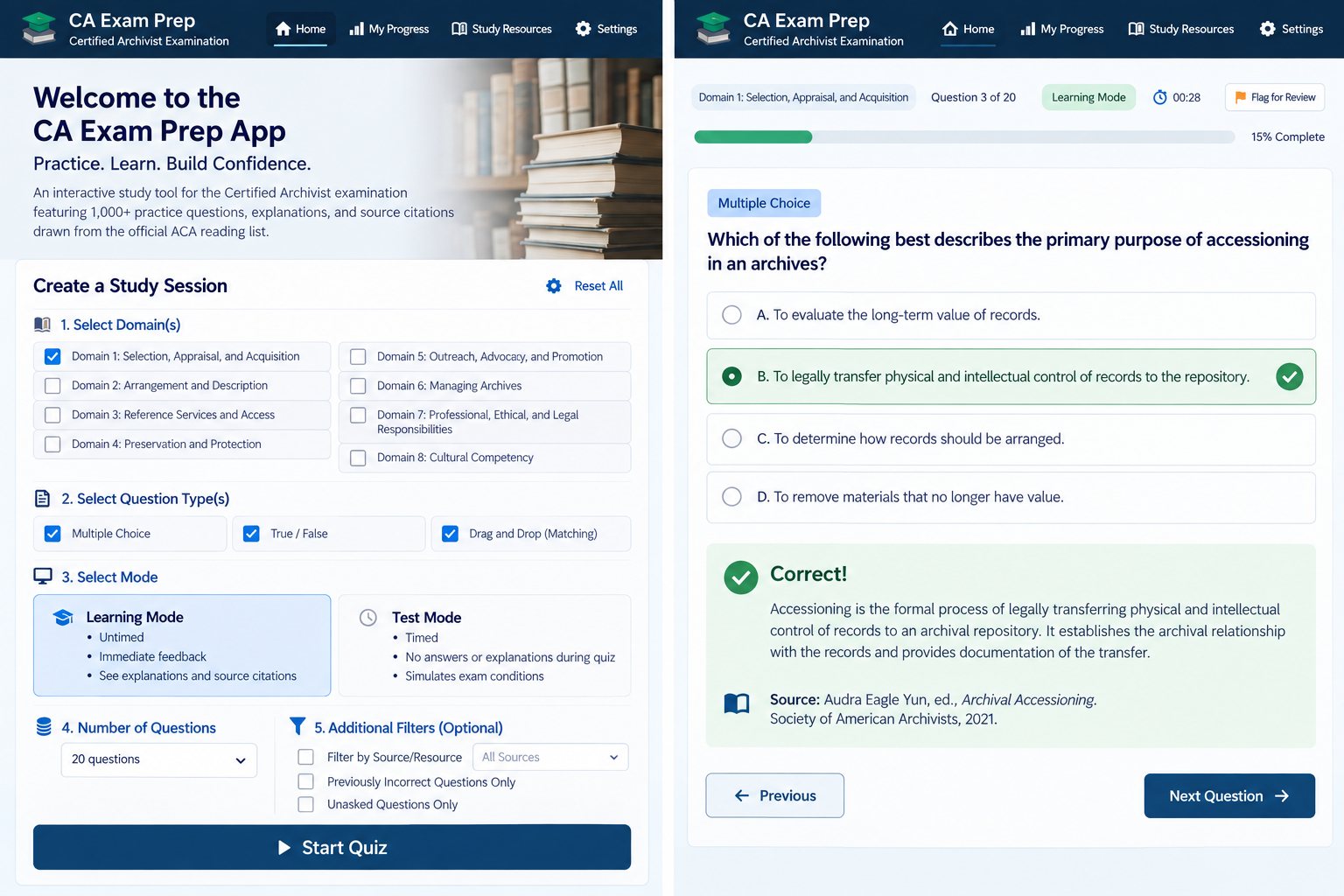
Interface recreated from development screenshots of the original app.
The challenge
The CA exam tests eight practice domains drawn from a reading list of roughly 50 books, articles, and standards, and ACA says questions come from that literature without a one-to-one link to any single reading. Candidates have the study guide and the list, but no structured way to practice against the full body of literature or to see which domains need the most work.
I was preparing for the exam myself in spring 2025, alongside full-time archival work. Generic flashcards and loose notes would not show me where I was weak, and they would not tie a missed question back to the source that explains it.
Approach
I built from the exam’s own framework outward rather than inventing a curriculum. The ACA Study Guide’s eight domains became the top-level structure, and the ACA Reading List became the source pool every question had to trace back to.
Three principles guided the work:
- Source-grounded: every question carries an explanation and a citation to the reading it came from, down to the page where possible.
- Structured, not prose: questions are records with consistent fields, so an application can filter, randomize, and score them.
- Diagnostic: results break down by domain, so the tool tells a candidate where to study next, not just how many they got right.
I used ChatGPT as a drafting and engineering partner: extracting concepts from readings, drafting questions and distractors, restructuring data, and writing and debugging code. I kept the subject-matter judgment, verification, and design decisions.
Process
The core build took about one week, from a first PowerPoint prototype on April 30, 2025 to a specified, coded app with three question formats by May 7. The following four weeks went into source coverage and study supplements.
| Date (2025) | Milestone |
|---|---|
| Apr 30 | Gathered ACA Study Guide and Reading List; drafted a 12-week study plan; began multiple-choice banks; built a PowerPoint quiz prototype |
| May 2 | Set question targets for all eight domains and by individual source |
| May 3 | Opened the quiz-code workstream and organized code by domain |
| May 5 | Completed a verified-answers pass across Domains 1–8 |
| May 6 | Wrote the interface specification; started a running count of finished questions by domain and format |
| May 7 | Added true/false and drag-and-drop tracks |
| May 10–14 | Built key-concept summaries and flashcards |
| May 15–29 | Built a book-and-source coverage matrix; added audio overviews and video lessons |
Data and metadata architecture
Each question is a record, not a paragraph. Drafting started in Word documents organized by source, moved into spreadsheets and CSV, and ended as JSON the app could load.
| Field | Purpose |
|---|---|
| ID | Unique identifier for traceability and reporting |
| Domain | One of the eight ACA domains; drives filtering and per-domain scores |
| Question type | Multiple choice, true/false, or drag-and-drop |
| Source | The reading the question was drawn from (for example, Boles or Ritzenthaler) |
| Citation | Page or section reference |
| Question, choices, correct answer | The item itself; choices stored once and shuffled at runtime |
| Explanation | Why the answer is correct, shown in Learning Mode and on review |
This is ordinary archival practice applied to assessment: consistent description, controlled values, and provenance for every item. The same fields that make a finding aid searchable make a question bank filterable by domain, source, and format.
Interface and learning design
The app had three screens (start, quiz, and results) and two modes that serve different stages of study. I specified the interface in a written design document on May 6, 2025.
| Feature | Learning Mode | Test Mode |
|---|---|---|
| Timer | Off | On, with optional per-question timer |
| Feedback | Immediate, green for correct and red for incorrect | Held until the end |
| Explanations and citations | Shown after each answer | Shown on the results screen |
A side menu let a candidate build a session by domain (one, several, or all), question type, and source. Two filters made it adaptive: Unasked Questions Only and previously missed questions. Navigation included Previous, Next, Submit, a Flag for Review checkbox, and a progress bar reading “5 of 60.”
The results screen reported an overall percentage and a percentage for each domain, so the next session could target the weakest area.
Quality assurance and source coverage
AI drafted quickly, so verification was a separate, deliberate step. On May 5, 2025, I ran a verified-answers pass across all eight domains, checking each correct answer and explanation against the literature before it went into the app.
I managed coverage with three tracking tools:
- Targets by source: planned counts per reading and format, for example 50 multiple-choice items from Harvey’s Preservation Management Handbook and 40 from Ritzenthaler.
- Running totals by domain: finished questions by domain and format, separate from the targets.
- Source coverage matrix: every reading-list item mapped to the domains it supports, with format (Kindle, print, PDF), whether I had it on hand, and whether I had read it.
The matrix showed gaps that question counts hid. In its first version, Cultural Competency drew on a single book, and the later version maps the reading list’s articles on radical empathy, community archives, and reparative practice to that domain.
Outcomes
I used the app to prepare for the exam and earned the Certified Archivist credential in 2025.
- Question bank: planning targets set on May 2, 2025 called for 1,484 items (1,274 multiple choice, 138 true/false, 72 drag-and-drop). The finished bank exceeded 1,000 questions.
- Working product: a coded web app with two study modes, multi-domain filtering, adaptive review, and per-domain scoring.
- Study ecosystem: study plans, a domain confidence tracker, key-concept summaries, flashcards, audio overviews, and video lessons built around the same domain structure.
- Reusable assets: the question data, design specification, and coverage matrix survived the loss of the app and are the basis for a rebuild.
Lessons learned
The most important lesson came from losing the app. After errors in the Replit project, I deleted it, and the code went with it. The question bank, design specification, and coverage tools survived because they lived in separate storage, apart from the code.
- Keep content and code apart. Content stored as structured data outlives any one platform. Code needs version control and off-platform backups.
- Verification is not optional. AI made drafting fast; a dedicated answer-verification pass made the questions trustworthy.
- Track coverage, not only counts. A high question count can still leave a domain thin.
- Write the spec before the code. A plain-language interface document kept a fast, AI-assisted build consistent.
- Document as you go. Dated project files made this reconstruction possible a year later.
Skills demonstrated and next steps
| Skill area | Evidence in this project |
|---|---|
| Archival subject expertise | Questions, explanations, and answer verification across all eight ACA domains |
| Instructional design | Learning and Test modes, adaptive review, domain diagnostics, study plans |
| Metadata and data architecture | Field schema, unique IDs, controlled values, Word-to-CSV-to-JSON pipeline |
| UX specification | Written interface design document covering screens, navigation, and feedback |
| AI-assisted development | ChatGPT for drafting, restructuring, and code, with human verification |
| Project management | Targets, running totals, and a source coverage matrix |
Next, I plan to rebuild the app as a subscription product, with the code under version control and the question bank maintained as a standalone, versioned dataset.
White paper
Back toAll workThe Ellie Lee Weems Photographic Negative Project
I led a team of volunteers and staff in the item-level arrangement and description of all 80,731 negatives in a 197-box collection documenting more than five decades of African American life in Jacksonville, Florida.
- Role
- Project Archivist (grant-funded)
- Institution
- Auburn Avenue Research Library, Fulton County Library System
- Extent
- 197 boxes (127 linear ft.), 1928–1979
- Status
- Processing complete; finding aid in ArchivesSpace
The collection
Ellie Lee Weems was the first licensed African American photographer in Jacksonville, Florida. His studio’s work records portraits, church gatherings, weddings, graduations, and civic and social life from the Great Depression through the Civil Rights Movement.
- Photographic negatives80,731 negatives · 119 boxes · 105.25 linear ft.
- Index card files61,667 cards · 67 boxes · 16.5 linear ft.
- Photo prints506 prints · 10 boxes · 4.75 linear ft.
- Supplementary materials9 folders · 1 box · 0.5 linear ft.
- Oversized mounted photograph1 item, certified by Weems
- Total197 boxes · 127 linear ft.
The challenge
Collections of this size are usually described at the box or folder level. This project went further: every one of the 80,731 negatives was arranged and described individually, so researchers can find a specific person, family, or event. Work at that level can’t be done without a system. It needed clear scope, a repeatable workflow, consistent metadata, trained help, and a way to track progress and quality as the project went on.
My role and process
I designed the system the project runs on, then trained more than a dozen volunteers, project assistants, and staff to work inside it. In my first month, I surveyed the entire collection, counted all 80,731 negatives across 132 boxes, and built the project tracker. I then broke the project into more than 50 tasks on a Gantt chart.
- Stage-based tracking. Every box moves through the same stages: counted, sorted by year, sorted by negative number, labeled, and entered into ArchivesSpace. The index card file follows a parallel track. A progress dashboard shows where each box stands and what is next.
- Item-level verification. Each negative is handled with gloves, and its identifying details are read from the negative itself rather than trusted from the sleeve. Sleeves are corrected to match, the index card file fills in missing names, negatives with several sleeves are marked in sequence, and unidentified negatives are sorted by whatever information survives so they can be researched later.
- Rehousing and quality control. A box-by-box review checks packing density, consolidates contents into standard 0.5 and 0.75 linear-foot boxes, and flags any box that needs a recount or resorting before it moves forward.
- Preservation planning. Nitrate negatives are counted by format to scope digitization of the most at-risk material.
- Item-level arrangement and description. Each of the 80,731 negatives is arranged chronologically and described individually in roughly 50 year-based series, with separate series for unidentified and undated material. The card catalog is arranged by year, then alphabetically. More than 850 subject headings created in ArchivesSpace, based on Library of Congress Subject Headings, keep description consistent.
- Data at scale. I personally entered data from all 61,667 index cards, bulk-imported about 63,000 item records into ArchivesSpace, assigned subjects and containers to thousands of records at a time, and built custom ArchivesSpace reports to track the team’s output.
- Access without handling. I digitized 67 fragile glass plate negatives, published them on HistoryPin with descriptive metadata, and linked them back to ArchivesSpace as digital objects, so researchers can view the images without anyone touching the glass.
Workflows I authored
Each one turned a recurring problem into a written procedure that a new volunteer could follow on day one.
- Nitrate negative workflowSafe handling and routing of at-risk film
- How to identify nitrate negativesQuick reference for volunteers
- Nitrate digitization prep sheetReadiness checklist for in-house scanning
- Oversized negative scanning workflowFlatbed digitization procedure
- Sleeve labeling checklistVerification standard for every negative
- Volunteer onboardingOrientation workflow, welcome sheet, and volunteer log
Impact
Together, the team and I arranged and described every negative at the item level. Processing is complete across all 197 boxes. As of September 30, 2026, all 80,731 negatives have been labeled and verified against the information on the negative itself, the collection is described in a finding aid in ArchivesSpace, and 258 items have been digitized.
Between January 2025 and August 2026, the team labeled more than 66,000 sleeves and sorted more than 15,000 negatives by number. In September 2026, we rehoused, reshelved, and renumbered 121 boxes and ran quality control on all 119 boxes of negatives.
The tracking work earned a Fulton County Library System Dewey Award, the “Spreadsheet Sorcerer,” in 2025.
Evidence
- Dewey Award, 2025“Spreadsheet Sorcerer,” Fulton County Library System
- Video: identifying people in negativesWatch on TikTok
- Finding aidPublished in ArchivesSpace
- Digitization258 items digitized
- Glass plate negatives on HistoryPin67 images, linked to ArchivesSpace
- Standards appliedArchivesSpace, Dublin Core, EAD, controlled vocabularies
- Collection imagesNot reproduced here, out of respect for the rights holders
Home / Work / Turner Library Services
Building Turner Library Services
Helping a historic seminary build physical and online library services from the ground up as it became an independent institution.
- Role
- Interim Librarian & accreditation consultant
- Institution
- Turner Theological Seminary
- Context
- Founded 1894; independent since 2024
- Focus
- Collections, instruction, accreditation
The challenge
Turner was founded in 1894 as the Department of Theology at Morris Brown College and became an independent theological institution in 2024. It needed library services built from scratch at the same moment three accrediting agencies were reviewing that new infrastructure.
My role and process
- Cataloged 400+ donated theological volumes into an accessible collection.
- Expanded digital research resources and individualized research support for students and faculty.
- Created the Demystifying the Library webinar series on information literacy, Zotero citations, and research databases.
- Created and branded the Turner Library YouTube channel and launched a video series for research instruction: library orientation, academic integrity, the Digital Theological Library, and Turabian style.
- Lead weekly information literacy instruction and start-of-semester orientation for graduate students and faculty.
- Supported accreditation documentation and reporting.
Impact
“Mrs. Murphy was not maintaining an established library system. She was helping Turner build one while that emerging infrastructure was being evaluated by three accrediting agencies.”Ammie L. Davis, Ph.D., President & CEO
Evidence
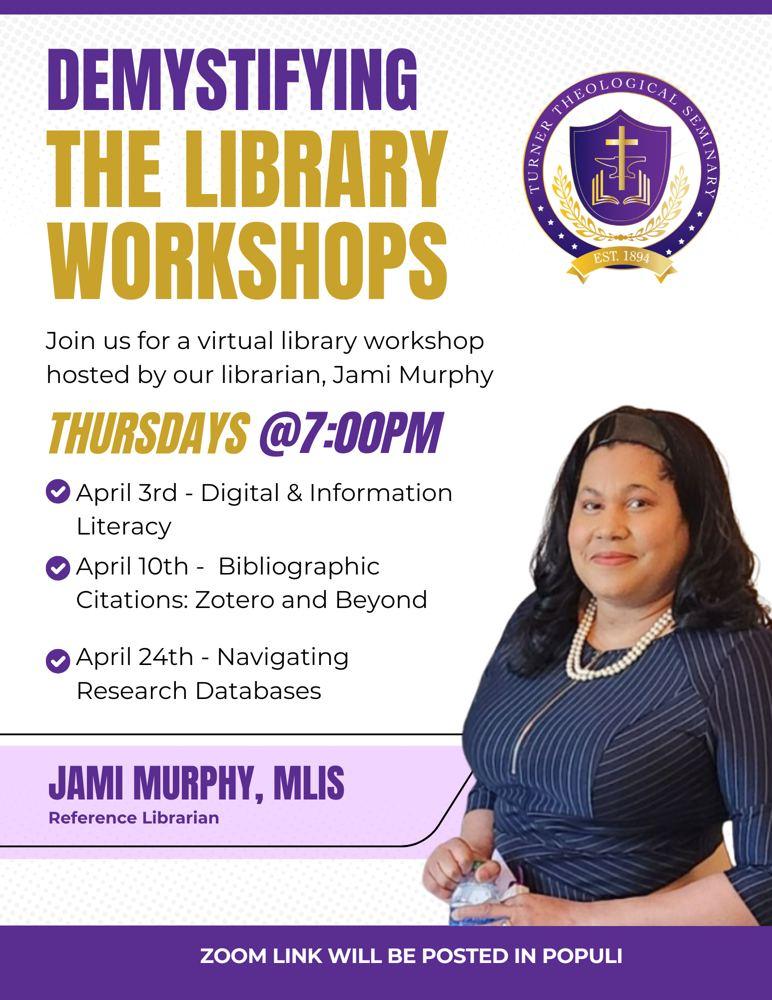
Virtual workshop series flyer
- Turner Library YouTube channelyoutube.com/@TurnerLibrarian
- Accreditation outcomesTRACS candidacy, ATS associate membership, SACSCOC candidacy
- Reference letterAmmie L. Davis, Ph.D., President & CEO (available on request)
Home / Work / NBAF Records Survey
National Black Arts Festival Records Survey
Assessing the records of a landmark Atlanta arts institution to guide preservation, arrangement, and access.
- Role
- Project Archivist
- Institution
- Auburn Avenue Research Library
- Extent
- About 54 linear ft.: 53 boxes and 3 unboxed items
- Status
- Surveyed; 88 items digitized
Scope and method
The survey documents condition, formats, preservation concerns, arrangement issues, and access risks across the collection, then recommends next steps for processing and digitization.
The records mix paper files with audiovisual materials, ephemera, and textiles, so the survey also flags rights questions and format-specific preservation needs, and assesses research value to set priorities.
This work runs alongside the Weems project, which means the method has to be efficient and repeatable.
- Wrote the survey and assessment plan after reviewing the accession records.
- Ran a full recount, labeled every box, and built a project workbook with container-level data for each one.
- Surveyed boxes against the original finding aid, and trained a volunteer to survey.
- Developed a digital exhibit strategy and digitized images for the National Black Arts Festival’s own digital exhibit project.
The study
The plan supports a three-year study of whether indoor heat affects sleep among adults 65 and older in six Atlanta neighborhoods that differ in tree canopy and housing stock. About 120 participants would have home temperature and humidity sensors, wear sleep trackers, and complete monthly surveys. The study and principal investigator are fictional; the plan is written to the standard a real NIH submission requires.
Protecting participants while sharing data
With about 20 participants per neighborhood, location, demographics, health answers, and sleep patterns could combine to identify someone. The plan balances maximum appropriate sharing against that risk:
- Location: home coordinates withheld; neighborhood-level detail released only after disclosure review.
- Small cells: any reported group under five participants suppressed or regrouped.
- Identifiers: ages and incomes banded, free text removed, device IDs replaced with random study codes, and calendar dates converted to relative study days.
- Access: record-level data proposed for ICPSR restricted use under a data use agreement; consent forms and the code key stored separately and never deposited.
Expected outputs
- Sensor, tracker, and survey dataICPSR, restricted use
- Derived heat and tree-canopy measuresICPSR, restricted use
- Disclosure-reviewed aggregate resultsZenodo, open access
- Python/Jupyter code, data dictionary, codebook, protocolZenodo, open access
Full plan available on request.
Research & instruction
Reference services, information literacy, and instructional design for students, faculty, researchers, and the public.
- Building Turner Library ServicesWebinars, research support, YouTube instruction
- Demystifying the LibraryVirtual workshop series
- Teaching Information Literacy CertificateThe Ohio State University Libraries, September 2026
- Reference librarianGeorgia Gwinnett College · RUSA member
Information organization
Archival description, metadata, controlled vocabularies, knowledge management, and digital asset management.
- Weems Photographic Negative ProjectLed a team in item-level description of 80,731 negatives; 197 boxes, 127 linear ft.
- NBAF Records SurveyMulti-format collection assessment
- Digital Asset ManagementProfessional certificate, University of Wisconsin–Madison
- Certified ArchivistAcademy of Certified Archivists
- Research data managementNIH data management and sharing plan in DMPTool
- Metadata standardsDublin Core, EAD, ArchivesSpace, DSpace
Application development
I design and build working tools: specifying the interface, structuring the data, and writing and testing the code, with AI as a development partner and human verification at every step.
- Certified Archivist exam prep appWeb app with 1,000+ questions, two study modes, adaptive filters, and per-domain scoring
- AI-assisted assessment frameworkWhite paper on building trustworthy AI-assisted tools
- Data pipelinesWord to CSV to JSON; bulk imports into ArchivesSpace
- Web customizationOmeka S pages in HTML, CSS, and JavaScript
- Tracking dashboardsExcel dashboards and custom ArchivesSpace reports
- ToolsReplit, Python, Jupyter, GitHub, HTML, CSS, JavaScript
Digital scholarship & AI
Digital exhibits and curation, Omeka S customization with HTML and CSS, and applied AI with clear human review and quality control.
- Softness Was Always OursTwo Leab Awards
- SAA E2 HourBuilding digital exhibits
- SAA AI Task ForceMember
- AI panel moderatorUsing AI for Collecting, Researching, and Writing, 2025
- Certified Archivist exam prep app1,000+ source-cited questions; AI Ambassadors in Libraries certificate
Project & operations leadership
Large-scale project management, workflow and process design, budgets, governance, and strategy, grounded in finance leadership.
- Treasurer, Academy of Certified ArchivistsPlus SAA Finance Committee
- Former CFO and controllerMBA, Management & Strategy
- CompTIA Project+Plus Columbia Business School CFO Program
- Archives Leadership Institute2026 cohort
Home / Teaching & Speaking
Teaching people to find, use, and tell stories with information
Presentation
From Negatives to Narrative: Building a Digital Exhibit from Archival Collections
Society of American Archivists E2 Hour, Reference, Access, and Outreach Section · April 29, 2026.
How do you turn thousands of archival images into a cohesive digital exhibit? The session covered selection strategy, thematic development, metadata decisions, and translating archival records into public narratives without compromising archival integrity. It drew record registration for the series.
Workshops & webinars
In the classroom and online
Turner Theological Seminary
Demystifying the Library
A virtual series on digital and information literacy, bibliographic citations with Zotero, and navigating research databases.
Turner Theological Seminary
Weekly instruction and orientation
Recurring information literacy instruction for graduate students, plus start-of-semester orientation for students and faculty.
Georgia Gwinnett College
Business Research Methods · Research Methods
Undergraduate instruction in source evaluation, database searching, and citation.
Georgia Gwinnett College
Student-worker career development
A workshop on practical professional skills.
Panels & presentations
At conferences and exchanges
Collecting, Researching, Writing: The Black Diaspora Conference · November 13, 2025
Using AI for Collecting, Researching, and Writing
Conceived, organized, and moderated an online panel on how AI is reshaping archival, library, and research practice, from metadata and digitization workflows to discovery, accessibility, and scholarly writing, with attention to ethics and limits. Panelists: Dr. Imani Cooper Mkandawire (Undisciplined), John Pasmore (LatimerAI), Dr. Sylvea Hollis (Montgomery College), and Dr. Kimberly Springer (Library Freedom Project). Watch the recording
Georgia Gwinnett College · April 2026
Alternative Careers in Library Science
Panelist on career paths for library science students.
Georgia Archives Exchange Day · December 2025
Weems collection presentation
Overview of the collection and processing approach for visiting archivists.
AUC Woodruff Library and HBCU Digital Library Initiative visits · 2026
Collection displays
Curated displays and talks on current processing and exhibit projects.
Media
Watch
Using AI for Collecting, Researching, and Writing
Panel I organized and moderated, November 2025.
VideoSoftness Was Always Ours at Auburn Avenue Research Library
Fulton County Library System video feature on the exhibit, August 2026.
VideoInside Softness Was Always Ours
A walk-through of the exhibit in the Small Gallery, Fulton County Library System TikTok, September 2025.
TikTokHow I identify people in photo negatives
Cross-referencing negatives with a spreadsheet built from the studio’s index cards, Fulton County Library System TikTok, August 2025.
TikTokThe Library Access TV Show, August 2026
Fulton County Library System monthly show featuring the exhibit’s unveiling.
VideoTurner Library on YouTube
A research instruction channel I created and branded for Turner Theological Seminary, October 2026.
ChannelTurner Library orientation, Fall 2026
The first video in a research instruction series for Turner students, alongside planned videos on academic integrity, the Digital Theological Library, and Turabian style.
Video
Home / Design & Communication
Design & communication
The materials that carry the work to its audiences: exhibit panels, instruction decks, outreach, and conference slides, all designed by me in Canva. Select any piece to enlarge it.
Auburn Avenue Research Library
Softness Was Always Ours: exhibit panels
Gallery panels from the 2026 revamp. Archival images are from Auburn Avenue Research Library collections and appear here as part of the panel designs. See the case study
Society of American Archivists
E2 Hour presentation, April 2026
From Negatives to Narrative: Building a Digital Exhibit from Archival Collections. About the session
Turner Theological Seminary
Library identity, outreach, and instruction
Georgia Gwinnett College
Assessing library instruction and usage, 2024
A plan for measuring whether library instruction makes a difference, from session-level data to retention and graduation.
Awards & honors
Recognition
- Leab Award, Excellence in Content (ACRL/RBMS), for Softness Was Always Ours2026
- Leab Award, Innovation in Audience Engagement (ACRL/RBMS), for Softness Was Always Ours2026
- Dewey Award, “Spreadsheet Sorcerer,” Fulton County Library System2025
- Distinguished Honors, Louisiana State University (MLIS, 3.95 GPA)2024
- Anthony Dees ScholarshipRecipient
Education
Degrees
Certifications
Continuing education
- Teaching Information Literacy Certificate: ten virtual workshops grounded in the ACRL Framework for Information Literacy for Higher Education (two more than the program requires), plus a written reflection on applying them to practiceThe Ohio State University Libraries, September 28, 2026
The ten workshops
- Teaching Research Practices with Small Teaching
- Transformative Information Literacy: Teaching for Perspective Transformation
- Teaching Information Literacy: Strategies and Resources
- Leveraging Librarian Faculty Partnerships to Demystify the Scholarly Conversation
- When Faculty Are Our Students: Exploring the Integration of Information Literacy After a Faculty Development Workshop
- Rethinking Roles: Faculty Development as an Approach to Teaching Information Literacy
- The Temporal Break: Why Information Literacy Must Adapt to AI
- Outdated Notion: Scholarly Articles Are the Gold Standard
- Navigating the Intersection of GenAI and the Evolving Information Literacy Framework
- Information Literacy: Definitions and Core Concepts
- Archives Leadership InstituteUniversity of Virginia, 2026 cohort
- Preventive Conservation: Care of Archives, Art, and ArtifactsGeorgia Archives, 2024
- Grants Management and ComplianceAssociation of School Business Officials, 2020
Jami Adkins Murphy, MLIS, MBA, CA
linkedin.com/in/jamimurphy · Atlanta metropolitan area
Summary
Research-focused librarian and archivist with experience in archival processing, metadata, digital curation, research support, instruction, and public-facing scholarship. Nationally recognized digital exhibit curator and presenter, with professional association leadership, experience building a theological seminary library through accreditation, and a prior career as a CFO and controller grounded in data integrity, documentation, and compliance.
Experience
Librarian I – Project Archivist
- Led a team of volunteers and staff in item-level arrangement and description of all 80,731 negatives in the Ellie Lee Weems Photographic Negative Collection, a 197-box (127 linear ft.) collection that also includes 61,667 index cards; processing complete, finding aid in ArchivesSpace, 258 items digitized.
- Completed labeling and verification of all 80,731 negatives (September 2026).
- Survey the National Black Arts Festival records, a 54 linear ft. multi-format collection (53 boxes and 3 unboxed items), identifying preservation, arrangement, rights, and research-value priorities; digitized 88 items.
- Apply metadata workflows using ArchivesSpace, Dublin Core, EAD, and controlled vocabularies.
- Trained and supervised more than a dozen volunteers, project assistants, and staff; authored nitrate handling, digitization, labeling, and volunteer onboarding workflows.
- Personally entered data from all 61,667 index cards; bulk-imported about 63,000 item records, and created 850+ subject headings in ArchivesSpace.
- Digitized 67 glass plate negatives on HistoryPin and linked them to ArchivesSpace as digital objects.
- Curated, designed, and project-managed the physical and digital exhibit Softness Was Always Ours, winner of two 2026 ACRL/RBMS Leab Awards.
Interim Librarian & Accreditation Consultant (part-time)
- Built library services from the ground up, including acquiring, accessioning, and cataloging a 400+ volume theological collection.
- Deliver research consultations, information literacy instruction, and orientation for graduate students and faculty.
- Supported library documentation for TRACS, ATS, and SACSCOC; no findings regarding library services.
Reference Librarian (part-time)
- Provided research assistance across in-person, virtual, chat, email, and phone channels.
- Taught information literacy for Business Research Methods and Research Methods; entered repository metadata in DSpace.
Archives Intern
Finance and Operations Leadership
- Chief Financial Officer, Charles R. Drew Charter School and Atlanta Classical Academy; Financial Controller, Multidisciplinary Association for Psychedelic Studies; Vice President of Accounting, League of Conservation Voters; fractional CFO and fraud examiner, Fohrman & Fohrman.
Leadership & Service
- Treasurer, Academy of Certified Archivists, 2026 – present
- Member, AI Task Force, Society of American Archivists, 2026 – 2029
- Member, Finance Committee, Society of American Archivists, 2025 – 2028
- Georgia Key Contact, Society of American Archivists, 2026 – 2029
- Member, E2 Advisory Board, Society of American Archivists
- Member, Digital Exhibits & Social Media Taskforce, Auburn Avenue Research Library (finished 37 days ahead of schedule)
- Archives Leadership Institute, University of Virginia, 2026 cohort
Honors
- ACRL/RBMS Leab Awards, Excellence in Content and Innovation in Audience Engagement, 2026
- Dewey Award, “Spreadsheet Sorcerer,” Fulton County Library System, 2025
- Distinguished Honors, Louisiana State University, 2024
- Anthony Dees Scholarship
Presentations & Projects
- From Negatives to Narrative: Building a Digital Exhibit from Archival Collections, SAA E2 Hour, April 2026
- Demystifying the Library webinar series, Turner Theological Seminary, 2025
- Organizer and moderator, Using AI for Collecting, Researching, and Writing, Collecting, Researching, Writing: The Black Diaspora Conference, November 2025
- Panelist, Alternative Careers in Library Science, Georgia Gwinnett College, April 2026
- Designed and built a Certified Archivist exam prep web app: 1,000+ source-cited questions, two study modes, adaptive filters, per-domain scoring, 2025
- White paper, Source-Grounded and Human-Verified: An Archival Framework for AI-Assisted Assessment Design, 2026
- NIH Data Management and Sharing Plan (practice plan), DMPTool, 2026
Education
- Master of Library & Information Science, Louisiana State University, 2024 (GPA 3.95)
- Graduate Certificate in Archival Studies, Louisiana State University, 2024
- Master of Business Administration, Management & Strategy, Western Governors University, 2015
- Bachelor of Science, Accounting, Western Governors University, 2012
Certifications
- Certified Archivist, Academy of Certified Archivists, 2025
- Teaching Information Literacy, The Ohio State University Libraries, September 2026
- Professional Certificate in Digital Asset Management, University of Wisconsin–Madison, 2023
- AI Ambassadors in Libraries, 2025 · Foundations of Legal Research, AALL, 2023 · Preventive Conservation, Georgia Archives, 2024
- CompTIA Project+ · Servant Leadership, Cornell University · CFO Program, Columbia Business School
Technical Skills
Archives & repositories: ArchivesSpace, DSpace, Omeka S, HistoryPin, FilmBox, Alma, Springshare. Metadata: Dublin Core, EAD, controlled vocabularies, subject headings, metadata quality control. Research & instruction: Zotero, Canvas, Blackboard, Camtasia, academic databases. Application development & data: web app design and build (Replit), JSON and CSV data pipelines, Python, Jupyter, HTML, CSS, JavaScript, GitHub, DMPTool, advanced Excel.
Languages
English (native) · Spanish (professional working) · French (limited working)
Home / Contact
Let’s talk about what you’re building
I’m interested in archives, digital information management, information strategy, library and archives technology, and organizations that serve knowledge-centered institutions. I’m also open to consulting on systems, projects, and complex information challenges.